
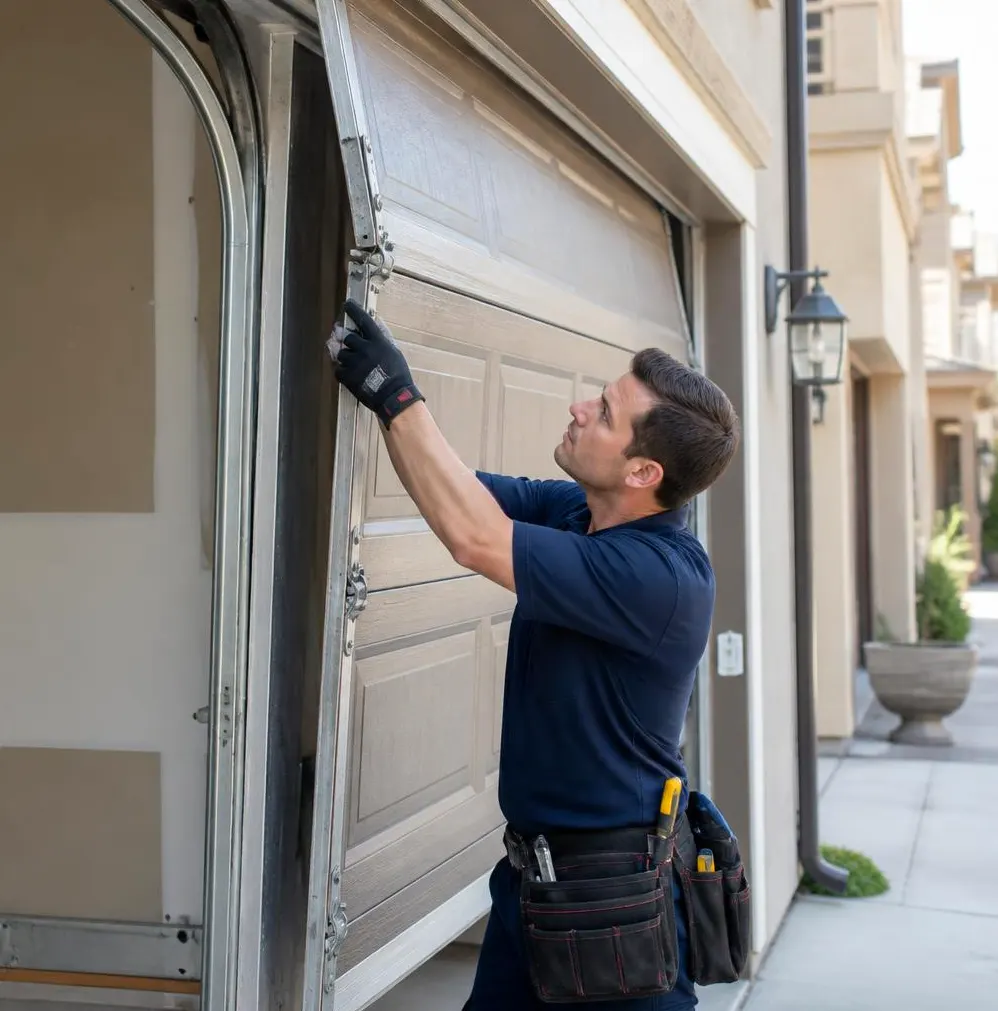
The short answer
A wound garage door spring holds enough stored energy to snap a winding bar out of your hands, launch metal fragments across a garage, or slam a 150-plus pound door down on anything underneath it. That's why spring replacement sends more DIYers to urgent care than almost any other home repair job. It's not a job made harder by lack of skill — it's a job made dangerous by physics most people never see up close until it fails.
What's actually happening inside that spring
Torsion springs sit above the door on a metal shaft and get wound tight enough to lift the entire weight of the door using leverage. Extension springs, mounted along the horizontal tracks, stretch under similarly high tension. Either way, the spring is a coiled piece of hardened steel holding hundreds of pounds of force in a space smaller than a coffee can.
When that tension is released in a controlled way, by someone using the right winding bars and a set sequence, nothing dramatic happens. When it's released uncontrolled — because a bar slips, a cone cracks, or someone tries to unwind it with a wrench or screwdriver — the spring can unwind in a fraction of a second, whipping the bar or shaft around with enough force to break fingers, fracture an arm, or hit someone in the face or chest.
How badly things go wrong
- Winding bar recoil: a slipped bar snaps back and strikes the hands, forearms, or face.
- Cable and spring fragments: a snapping cable or spring under tension can send metal pieces flying with real force behind them.
- Door drop: if the spring lets go while the door is disconnected from the opener or only partially supported, the door itself can fall, which is especially dangerous with anyone standing underneath or reaching into the track.
- Crush injuries to hands: most non-catastrophic injuries happen when fingers get caught between coils or in the track during reassembly.
None of this requires an obviously broken setup. Plenty of injuries happen on springs that looked fine, because the person doing the work didn't realize how much tension was still in the system.
Why Alabama weather makes this worse, not better
Humidity and swings between heavy summer rain and dry stretches push rust onto spring coils and cable ends faster than in drier climates. A rusted spring doesn't fail more gently — it often fails more suddenly, because corrosion creates weak points that let go without warning instead of stretching or deforming first. Homes near Gadsden, Southside, and the rest of Etowah County see this pattern often enough that a spring that's been making noise or visibly rusting for a season is already past the point where a confident DIY attempt is a good idea.
What actually prevents injury
- Don't touch the springs themselves. Visual inspection is fine — look for gaps in the coil, rust, or a spring that looks stretched or uneven compared to its pair. Don't attempt to wind, unwind, or remove it.
- Test door balance the safe way. With the opener disconnected, lift the door manually about halfway. It should stay put. If it drifts up or crashes down, the springs are compensating incorrectly and need professional attention, not adjustment.
- Never work under an open door that isn't propped with vice grips or a locking pliers on the track. This is what prevents a sudden drop from becoming a crush injury.
- Replace both springs at the same time, even if only one has failed. Mismatched spring age is one of the most common reasons a second spring fails within weeks of the first, often while someone is standing nearby thinking the repair is already finished.
- Leave winding entirely to someone with the right bars and training. There's no substitute tool that makes this safer — screwdrivers, pliers, and improvised bars are involved in a disproportionate number of injuries.
When to call Rainbow City Garage Door Solutions
If your door is slamming down, creeping up on its own, or you've spotted rust or gaps along the coil, that's a spring replacement call, not a weekend project. We bring the right winding bars, replace both springs as a matched pair, and check cables and tracks at the same time, since a failing spring often means a stressed cable too. If you're not sure whether what you're seeing is a spring problem or something else, our preventive maintenance visits catch worn springs, rust, and cable wear before they turn into a failure at the worst possible moment — usually when the door is half open and someone's underneath it.
If your garage door spring looks worn, sounds off, or the door just doesn't feel balanced anymore, call Rainbow City Garage Door Solutions. We serve Rainbow City, Gadsden, Southside, Attalla, Glencoe, Hokes Bluff, Albertville, and Boaz, and we'd rather replace a spring now than help after an injury later.